
The Ultimate Guide to Cross Platform App Development for Business Owners
Every business today wants a mobile app, but building separate apps for iPhones and Android phones adds to costs and takes time. This problem is solved by cross platform mobile app development which involves a single codebase being written that works on both iOS and Android.
Also called hybrid app development, this type has been embraced by startups in particular, because with it, they can launch faster with decent output quality.
In this guide, you will understand: how cross-platform development actually works, which frameworks deliver the best performance, when choosing this route over native development makes sense, and what you can expect to pay and the limitations you need to watch.
This knowledge will help you make an informed decision before any development team is hired.
What Is Cross Platform App Development?

As discussed, with this approach, a business can build one application that runs on both iPhones and Android devices without separate code being written for each.
Findings reveal that the global market for these frameworks stood at USD 124.5 million in 2025. By 2032, that figure is expected to reach USD 369.2 million. This jump reflects a simple reality: companies want less spending and more users being reached.
The technique used in cross platform development is technically called the "Write Once, Run Anywhere" approach. For businesses and founders, this means:
On both major mobile platforms, a single codebase powers applications
The same code gets reused across environments instead of being rewritten
Because only one project needs to be managed, deployment happens faster
This explains why cross platform development is a popular choice across industries due to cost reduction and faster timelines achieved through this approach.
How Cross Platform App Development Works

Cross platform app development relies on two core ideas that work together. These are a shared codebase and a bridge that connects that code to each operating system.
The Shared Codebase Concept
Instructions are written once for both Android and iOS. With a shared codebase, the core logic, business rules, and data handling all reside in one place.
This finding is confirmed by a study that states that code can be shared across multiple operating systems through cross-platform frameworks.
How Frameworks Act as a Bridge
In mobile app development, direct communication between the shared code and either device will be time consuming if done from scratch.
According to literature, the behavior of different programming languages is mapped by a bridge so that common resources can be shared. When access to a phone's camera or storage is needed by the shared code, the frameworks translate code into commands that the operating system recognizes. This translation happens in real time.
These bridges come already included with popular frameworks like Flutter, while React Native now uses JSI (JavaScript Interface) for direct communication instead of a bridge (since v0.76).
Popular Cross Platform Frameworks for Mobile Apps
Several cross platform frameworks have emerged as industry standards. Each one takes a slightly different approach to solving the same problem: building apps that work everywhere.
Flutter
Flutter comes from Google and uses a language called Dart. As shown in several performance benchmark studies, Flutter allows precise control over how an app looks and feels.
For instance, complex animations and large lists are handled more smoothly than its alternatives in many cases. This makes Flutter particularly suitable for visually demanding applications.
Pro: More efficient CPU usage and fewer frame drops during resource-intensive operations in many realistic scenarios
React Native
React Native, created by Facebook, uses JavaScript, a language that is widely practiced by developers. Between the code and the phone, a bridge translates commands back and forth.
Now, the framework comes with new architecture and improvements, though some communication overhead remains in practice. Compared to Flutter, React Native delivers faster startup times on iPhones in typical business-app workloads. These characteristics make it a strong choice for iOS-first strategies.
Pro: Smaller app size and faster cold-start times on iOS devices
Ionic
Ionic takes a web-first approach. In this framework, standard web technologies like HTML, CSS, and JavaScript are wrapped into a container that runs like a mobile app.
This framework fits best in projects where speed and time-to-market matter more than pixel-perfect native control.
Pro: A lower learning curve for web developers already familiar with standard tools
Advantages of Cross Platform Mobile Apps for Businesses
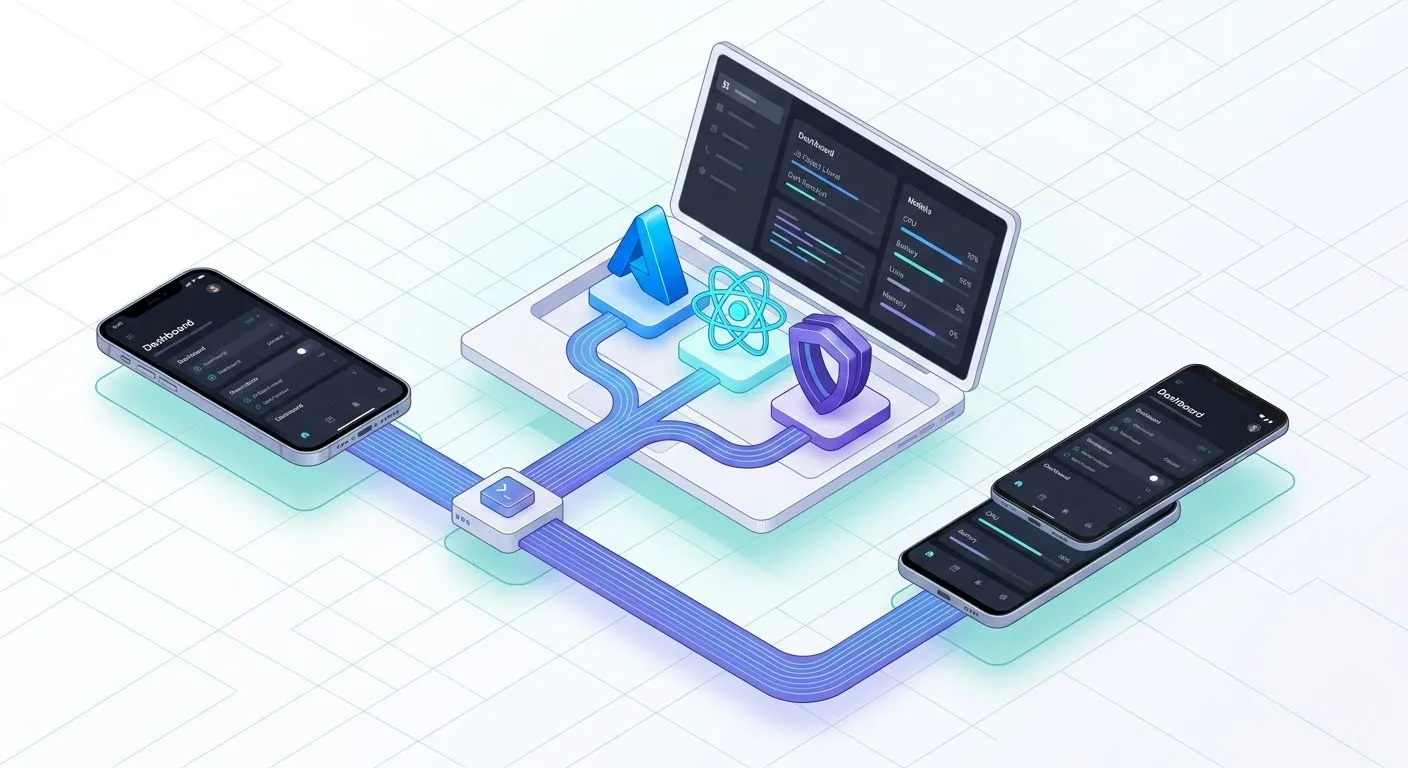
Cross platform mobile apps have moved from an experimental option to a standard business practice.
Here is why companies are making the switch:
Lower Development Cost
By hiring one team instead of two, the initial investment is cut substantially. Businesses no longer have to pay separate developers to write the same features twice for iOS and Android.
This saving is especially attractive for new startups, a variable that determines which startups survive their first year.
Faster Time to Market
When a single codebase is used, development, testing, and approval are completed on one unified project.
According to research, development processes and launch timelines are accelerated by cross-platform frameworks like React Native for early-stage companies.
Code Reusability
Code written once can be used everywhere. This way, it becomes possible to achieve broadly consistent performance across both operating systems for business logic, data handling, and backend connections.
Easier Maintenance
Fewer codebases mean there will be fewer places where bugs can hide. This means that, when an update is needed, changes can be made in one location and then deployed to all users simultaneously.
Wider Audience Reach
When launching on both app stores from day one, potential users are doubled without doubling the workload.
Budget constraints and manpower limitations make this particularly valuable for startups. This way, without waiting months for a second version, reaching a wider audience reach becomes possible.
Effective for New Startups
With this kind of development, ideas can be tested by founders, feedback gathered, and mobile development steps completed quickly before committing to native development for specific features that may eventually demand it.
Such an iterative approach has become a commonly cited recommendation in industry research on startup success.
Disadvantages of Hybrid App Development
You cannot avoid tradeoffs with any development choice, and cross-platform is no exception. These tradeoffs become especially important when your app demands peak performance or deep device integration.
Performance – In cross-platform apps, there is an extra layer between the code and the device hardware whenever they use WebView to display their interface. This limitation becomes noticeable for applications with heavy graphics or real-time processing, as documented in this study. This means gaming apps or video editing tools may struggle under the hybrid model.
Framework Dependency – Your project relies on a third-party framework that you do not control. This means that until that framework adds support, your app cannot take advantage of new device features in operating-system updates. This dependency becomes a risk when Apple or Google releases urgent security patches that your framework does not yet support.
Native Features – Compared to building directly for each platform, access to certain phone capabilities may be limited. This is especially relevant for requirements involving deep integration with biometric sensors, advanced camera controls, or background processing. Such limitations matter most for healthcare apps that rely on fingerprint authentication or fitness trackers that need continuous background location.
UI Consistency – Because hybrid apps do not automatically adopt native design patterns, matching the look and feel of each platform requires extra effort. When an app has poor user interface and user experience, it can lead to friction that hurts engagement. This inconsistency becomes a problem for consumer-facing brands where UI and UX directly affect trust and conversion rates.
Cross Platform vs Native Apps: Key Differences
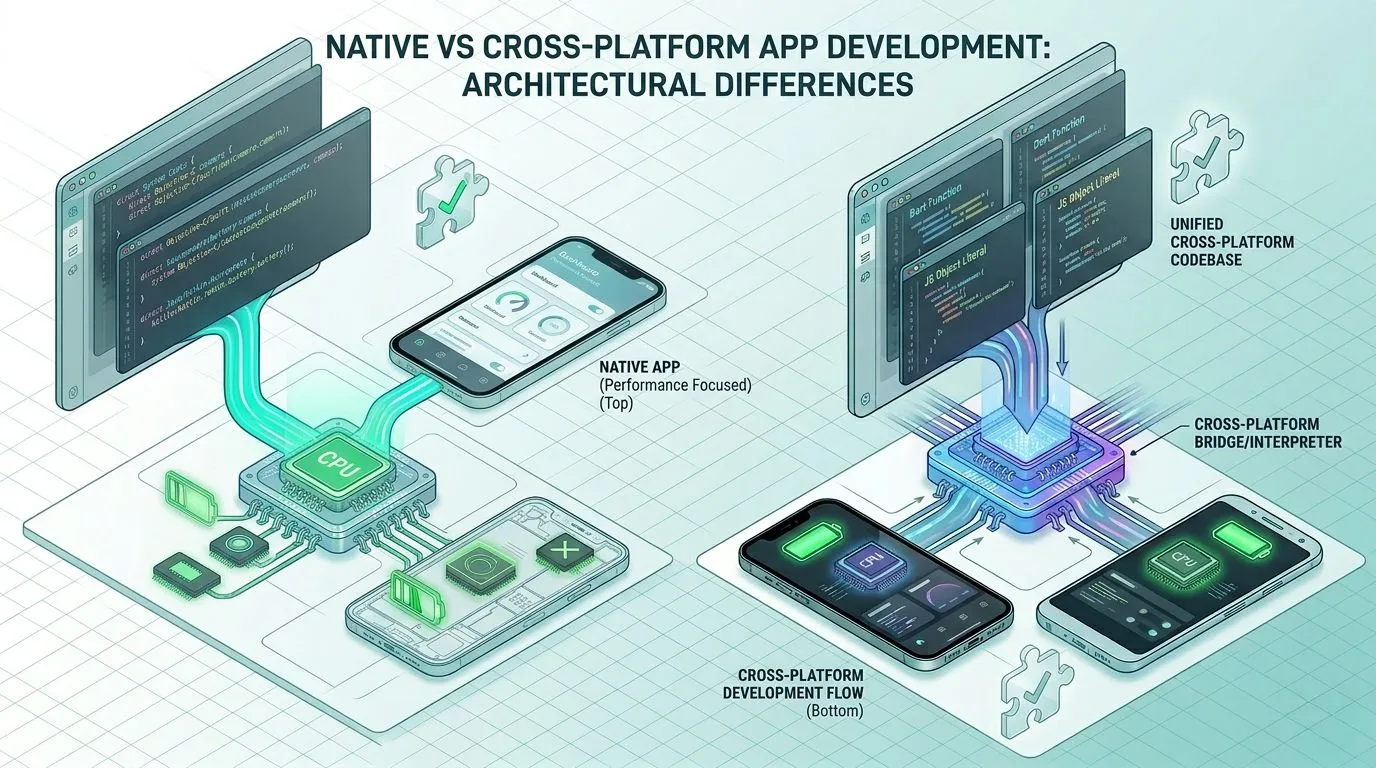
It is essential to understand the factors that compare cross-platform vs native apps, as they directly affect your business. This comparison will help you match the right approach to your specific project needs.
| Factor | Cross-Platform | Native |
|---|---|---|
| Performance | Satisfactory for most use cases, though an extra layer exists between code and hardware. | Highest possible performance for a graphics-intensive game or an app that needs every ounce of device performance. |
| Cost | More cost-effective, with one team building for both platforms. | Higher cost, as separate teams for iOS and Android are required but offer complete control and no compromises. |
| Development Time | Faster, because code is written once and deployed everywhere. | Slower, due to building and testing two separate applications. |
| User Experience | Good, though slight differences may be felt across platforms. | Provides the most native look and functionality. |
| Scalability | Works well for most apps, though complex features may encounter limitations. | Scaling is smooth without platform-imposed ceilings. |
| Decision Rule | Any app that does not need direct device integration. | Those apps that require device integration and high-quality UI and UX. |
When to Use Cross Platform App Development Services
Knowing when to bring in cross-platform app development services for the various types of mobile apps will save you both money and headaches.
According to market research, rising demand for mobile applications across industries and the need for cost-effective solutions continue driving adoption of this approach.
Building an MVP
A minimum viable product helps you reach users fast before spending heavily on native development.
This step tests whether anyone actually wants your app. This is especially necessary for startups still in the exploratory and research phase. Within three months of using one developer team, a food-delivery startup launched its MVP on both stores, after which seed funding was raised based on real user data.
Working with Limited Budget
In a situation with tight cash flow, it is usually impractical to hire two engineering teams for mobile development. This problem is solved by the cross-platform approach due to the production of a single, re-usable codebase.
For example, a fitness-tracking app costs under $40,000, while a native version may start at around $85,000 for the same features.
Targeting Both iOS and Android Quickly
Not targeting both platforms at the same time is like leaving money on the table and means losing out on opportunities.
Cross-platform allows you to reach potential users present on both platforms from day one. Ticketing platforms, for example, capture both iPhone and Android audiences during a single festival season.
When to Avoid Cross Platform Application Development Services
For many projects, cross platform application development services work wonderfully. But they have limits that must be recognized if disappointment is to be prevented.
High-Performance Apps (gaming, AR/VR) – the extra layer between the code and hardware produces a lag that ruins real-time experiences. In these applications, every millisecond counts, narrowing the room for any lag by hybrid app technologies.
Deep Hardware Integration – Compared to native development, access to certain device capabilities may be limited. This is a reason why advanced camera controls or biometric sensors become harder to implement reliably.
Complex Animations – Continuous framework adaptation is required by frequent operating system updates. Due to this high requirement, smooth frame rates may become difficult to maintain across both platforms simultaneously.
Cross Platform Mobile App Development Services: Cost Breakdown
Simple Apps ($10k–$40k)
A straightforward product with limited interactivity, such as a company directory or a tip calculator. Their backend demands remain minimal.
Mid-level Apps ($50k–$120k)
This includes user accounts, payment gateways, or live data retrieval requiring each integration to function identically across operating systems.
Complex Apps ($150k+)
Applications handling sensitive information or real-time synchronization, like telehealth portals or logistics trackers, requiring security audits and custom infrastructure.
Features: Push alerts, media uploads, or offline storage each demand separate development cycles and testing regimens.
Integrations: Connecting the app to existing enterprise software, wearable devices, or mapping tools adds layers of compatibility work.
Design: Custom transitions, gesture controls, and platform-specific navigation patterns take longer to refine than standardized layouts.
Team: Geographic location of developers, seniority levels, and the inclusion of quality assurance specialists all shift the final invoice.
These cost factors of the mobile app development process separate a predictable investment from a project that continually exceeds its original estimates.
How to Choose a Cross Platform Application Development Company
Selecting a cross platform application development company requires matching their delivery approach to your product's complexity and launch window.
| Project Type | Estimated Timeline |
|---|---|
| MVP | 2–4 months |
| Standard Apps | 4–8 months |
| Complex Apps | 8+ months |
Your choice gets shaped by how promptly stakeholders approve milestones, how many external APIs the app depends upon, and whether feature requests shift after development begins.
A partner who presents a weekly breakdown and delivers testable builds through committed deadlines will reliably outpace one offering only a single launch date. This is why it is critical to understand the mobile development process yourself so you can hire smartly and as per your project requirements.
Real-World Examples of Cross Platform Mobile Apps
Even billion-dollar products trust cross platform technology to deliver consistent experiences without doubling their engineering workload.
The social platform embedded React Native into key features such as Push Notifications and Stories-related UI. A case study explains how maintaining two separate native codebases had grown too expensive, so adopting cross-platform lowered those costs while accelerating feature releases.
Google Ads
Google's Ads app leverages Flutter and native components to deliver smooth performance across both operating systems. This approach uses a framework that compiles directly to native code, minimizing the overhead seen in older WebView-based solutions.
Alibaba
Their Xianyu marketplace, serving over fifty million users, adopted Flutter as a core client-side framework to unify Android and iOS development. This transition improved R&D efficiency and allowed more frequent new-feature rollouts, which had been challenging under their earlier architecture.
The Future of Cross Platform App Development
Market projections place cross platform app development at the center of a growing industry.
A 2026 report notes that the global mobile application market is projected to grow from around USD 330–331 billion in 2025 to about USD 378 billion in 2026, with cross-platform development forming a large share of that expansion.
Growing Adoption of Flutter: Enterprises favor Flutter for projects demanding rich animations and custom designs. Its compilation method removes the performance bridge found in older frameworks, whereas React Native works better for teams already familiar with React.
Improved Performance: Modern rendering engines handle complex logic and real-time data processing with little measurable difference from fully native applications.
Stronger Ecosystem: Third-party plugins and hardware access libraries have matured to the extent that developers now rarely write platform-specific code as a workaround.
Rise of Cross-Platform-First Startups: Early-stage companies default to frameworks like React Native or Flutter from day one. Native development on the other hand gets reserved only for isolated features where performance is deemed critical.
This trajectory suggests cross-platform knowledge will become standard rather than specialized within the broader future of mobile development.
Making The Cross Platform vs Native Decision
The choice between cross platform vs native comes down to three variables: available budget, desired launch date, and acceptable performance requirements.
For startups and most mid-sized companies, cross-platform accommodates solutions for both iOS and Android, removing the need for hiring two entirely separate development teams.
That said, native development on the other hand is an undisputable choice for applications demanding heavy animations, graphics-intensive rendering, or direct hardware access at low levels.
The actual cost-performance tradeoff will be understood after you have carefully mapped out specific feature requirements that your product needs. Rather than guessing, consult experts before deciding who will guide you about your feature list and produce a realistic comparison based on ground realities.
Frequently Asked Questions (FAQ)
Q: What is cross platform app development?
This development type allows writing one codebase that deploys to both iOS and Android. Native development, by contrast, requires separate code written specifically for each operating system.
Q: Is cross platform better than native?
Neither option holds a universal advantage. Cross-platform cuts development time and cost, but native development delivers smoother animations and faster access to hardware-specific components like cameras or motion sensors.
Q: Which framework is best for cross platform apps?
No single framework works best for every situation. React Native suits teams coming from web development backgrounds, while Flutter is used on projects requiring custom animations and visually consistent designs across both platforms.
Q: Are cross platform apps slower?
Performance is dependent on the framework that gets selected. For example, Flutter pairs fluidly with native code. React Native, however, depends on JavaScript that may introduce minor overhead during complex animations. This is barely noticeable in routine business tasks such as forms, data entry, or list navigation, as users will detect no significant difference.
Q: Can cross platform apps scale?
Yes, numerous enterprise applications scale effectively on cross-platform technology. Alibaba Xianyu and Instagram are good examples.